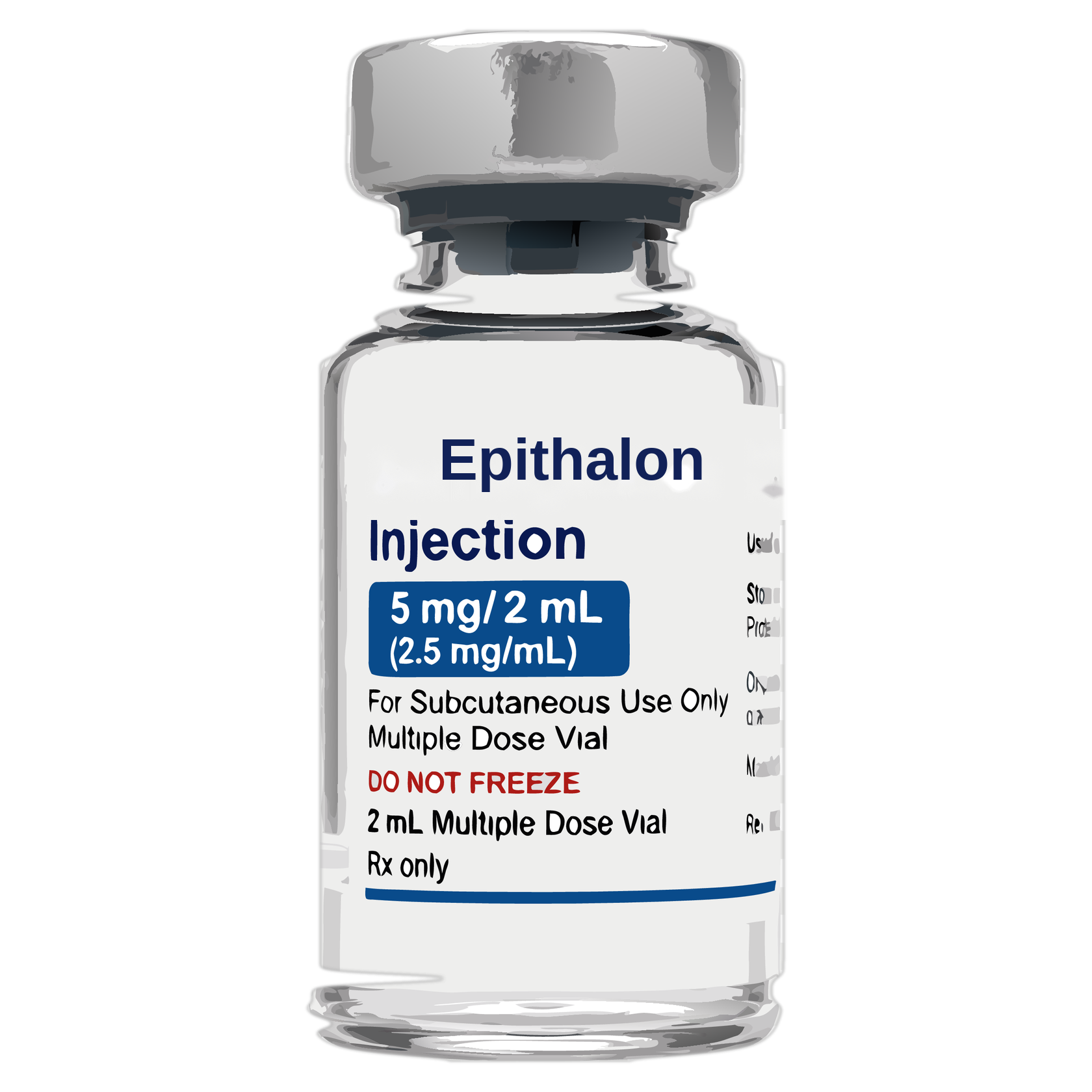
Epithalon
Epithalon is a synthetic four-amino-acid peptide developed from pineal gland extract research, studied primarily for its potential effects on telomerase activity and cellular aging markers.
- Studied for telomerase activation in laboratory research
- Researched for pineal gland and melatonin regulation
- Explored in longevity-focused cellular research
No commitment · Cancel anytime · Physician evaluation required
About Epithalon
Epithalon (also spelled Epitalon, sequence Ala-Glu-Asp-Gly) was developed by Russian gerontologist Vladimir Khavinson from research into Epithalamin, a pineal gland extract. Decades of research — largely from Russian and Eastern European institutions — have examined its effects on telomerase activity, pineal melatonin regulation, and lifespan in animal models.
What the research shows — and its limits
A 2025 comprehensive review in PMC (National Institutes of Health) summarizes over 25 years of in vitro, in vivo, and computational research showing Epithalon stimulates telomerase activity and hTERT expression in cell models, with reported lifespan extension in animal studies without observed tumor-promoting effects. However, the review is direct that the number of rigorous, independently-replicated Western clinical trials remains limited, and much of the human-outcome literature originates from a small number of Russian research groups using methodologies that haven't been widely replicated internationally.
Who it's for
Epithalon is generally considered by adults interested in cellular aging and longevity-focused wellness programs, understanding this is an area of active but still-developing research.
How It's Administered
Epithalon is typically administered as a subcutaneous injection in cycles (a period of daily dosing followed by a rest period), a pattern drawn from the original Russian research protocols. Your physician will determine an appropriate schedule during your evaluation.
Safety & Considerations
Available safety data, largely from animal studies and a limited body of human use, has not identified significant toxicity at studied doses. However, long-term safety data in the rigorous, large-scale sense expected of FDA-approved medications does not exist for this compound.
Your physician will discuss these considerations during your evaluation. Not all applicants will qualify.
Selected References
The following peer-reviewed sources informed the summary above. Evidence quality varies — some reflect large controlled human trials, others early-stage or animal research, as noted.
- Overview of Epitalon—Highly Bioactive Pineal Tetrapeptide with Promising Properties
PMC (National Institutes of Health), 2025