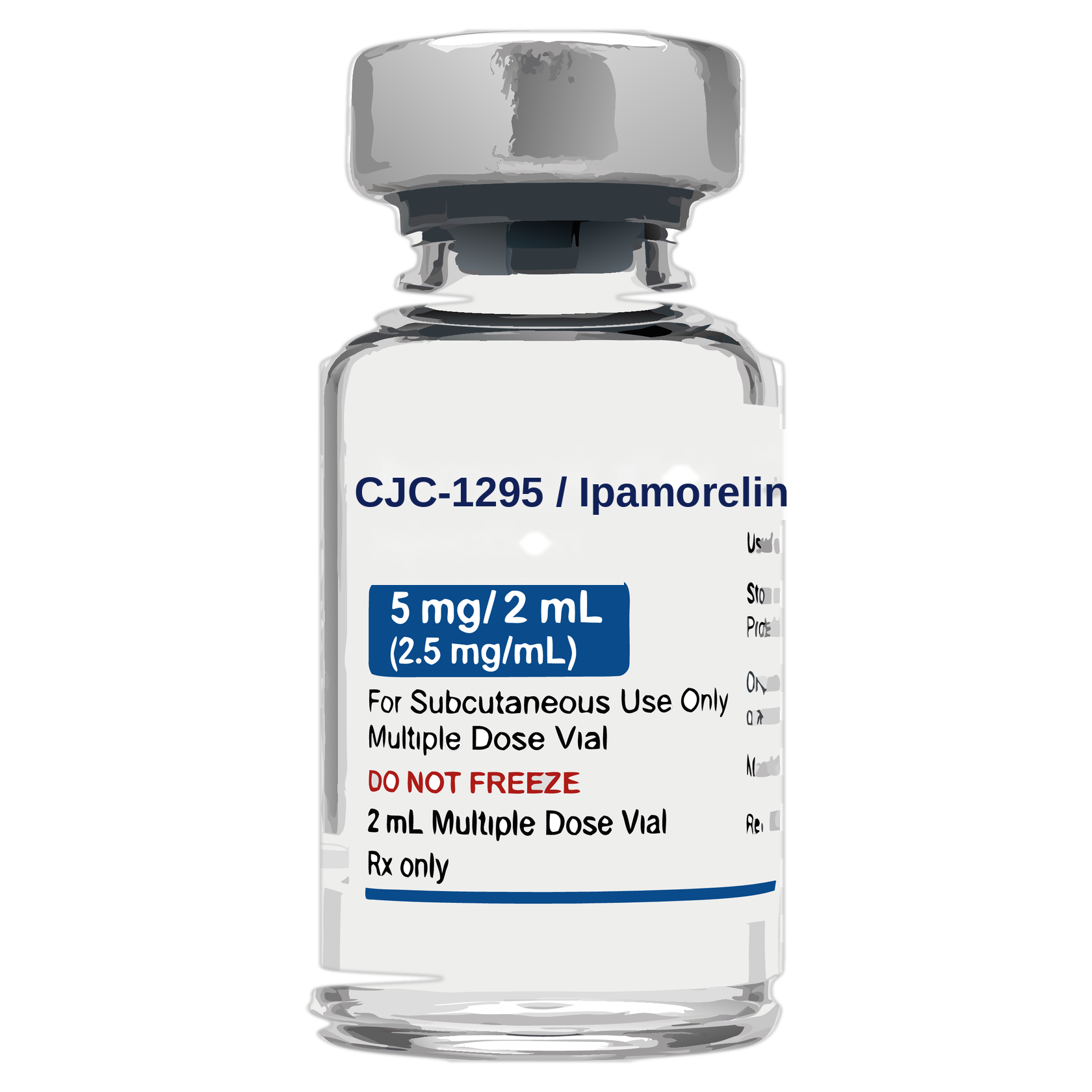
CJC-1295 / Ipamorelin
CJC-1295 is a long-acting GHRH analog; Ipamorelin is a selective ghrelin-receptor secretagogue. Together they're intended to amplify natural, pulsatile growth hormone release through two separate mechanisms — one of the most widely used GH peptide combinations in wellness medicine.
- Long-acting GHRH analogue paired with a GH secretagogue
- Associated with enhanced GH pulses in human trials
- May support recovery and body composition
No commitment · Cancel anytime · Physician evaluation required
About CJC-1295 / Ipamorelin
CJC-1295 is a modified GHRH(1-29) analog engineered with a Drug Affinity Complex that binds serum albumin, extending its half-life to days instead of the minutes native GHRH lasts. Ipamorelin is a pentapeptide that selectively activates the ghrelin receptor (GHS-R1a) without significantly affecting cortisol, prolactin, or ACTH — a cleaner profile than older-generation GH-releasing peptides.
What the research shows
CJC-1295's human pharmacology was established in a 2006 Journal of Clinical Endocrinology & Metabolism study (Teichman et al.) — two randomized, placebo-controlled, double-blind trials in healthy adults showing dose-dependent GH increases of 2- to 10-fold, sustained for 6 or more days after a single injection, with IGF-1 elevated for 9-11 days. A companion 2006 study confirmed GH continued to be released in natural pulses rather than continuously. Ipamorelin's selective pharmacology was established by Raun et al. (1998). Worth noting: CJC-1295's original commercial development was discontinued after a trial participant's death, though it was determined unrelated to the study drug. The specific CJC-1295 + Ipamorelin combination itself has not been studied together in a dedicated published human trial.
Who it's for
This combination is commonly considered by adults interested in GH-axis support for recovery, sleep, and body composition.
How It's Administered
Both peptides are typically administered as a subcutaneous injection, often at bedtime. Your physician will determine dosing and frequency during your evaluation.
Safety & Considerations
The Teichman 2006 trial reported injection site reactions as the most common adverse event, with no serious adverse reactions at tested doses. GH-class effects to monitor include water retention, and IGF-1 elevation above the age-adjusted reference range at higher doses. Ipamorelin's cleaner receptor selectivity means less appetite stimulation and hormonal cross-talk than older secretagogues.
Your physician will review your health history during your evaluation. Not all applicants will qualify.
Selected References
The following peer-reviewed sources informed the summary above. Evidence quality varies — some reflect large controlled human trials, others early-stage or animal research, as noted.
- Teichman SL, et al. Prolonged stimulation of growth hormone and IGF-I secretion by CJC-1295 in healthy adults
Journal of Clinical Endocrinology & Metabolism, 2006 (PMID 16352683) - Raun K, et al. Ipamorelin, the first selective growth hormone secretagogue
European Journal of Endocrinology, 1998